Audio

We want the app to be a tool, a springboard to get out and move. For this we have designed the app to be used before and after activities outdoors mostly. We do not want the user to have to stop and stare at their screen when they are out, but rather use that time to connect with their surroundings or simply zone out. Since many find listening to music to make activities more enjoyable, we will encourage such listening. However, there are dedicated music applications that can be used for this, and it is beyond our scope to compete with them.

There are some built in background music tracks, and sound effects, which set the fantasy mood. These will play when you are using the app but not doing a physical activity. They can be muted in settings. They are also temporarily muted automatically when the app registers other sounds being played on the phone, i.e. from Spotify.

:: Written by Anette Rana ::

World, Story, Characters

3-01

World

The core of the app is to make walking activities in the local area more exciting and engaging, by adding a gamified layer to the GPS. The user can build structures in real world locations, but they are only seen on the phone. We first thought to create a sci-fi themed world around these mechanics, to explain why the structures are only digital. However we decided that it was better to make the structure feel more tangible than abstract data. We want to give the user the feeling that they have left a real mark on their surroundings. We considered having a real world settings, but found it too limiting. In the end we decided on a fantasy themed setting, which feels familiar and tangible, while also allowing for extraordinary fantasy.

Malone claims that using fantasy creates images of things that are not really there, which is what we aim to do. He states that using fantasy has cognitive and emotional advantages for designing an instructional environment, which is very relevant for us as we want to teach the user how to use their physical environment. (Kapp, 2012, p. 55)

The activities of the user is carried out in a virtual fantasy world, which allows for more extrinsic motivation. At the same time it is carried out in the real world. Moving from structure to structure is a means to progress in the fantasy world, while simultaneously highlighting the functionality of the activity. The user is learning to stay active, to set small goals to get to places of interest. We use the game elements of the virtual world to contextualize the utilitarian activity. (Kapp, 2012, p. 58)

2-01

Story

By using story elements the user can get richer memories, which are easier to recall in relevant situations. (Kapp, 2012, p. 168) Where a plain fitness app would only record the users activity and give the stats, this app weaves the users activities into a story narrative. The user is a novice magician in training, and builds magical structures, gathers resources and helps people they meet.

1-01

Characters

There are different characters in the game. The user has an avatar which they can customize. This avatar represents the user. We initially planned to have one mentor, but studies show that users learn significantly more when it’s roles are split into expert and motivator. (Kapp, 2012, p. 100) Their characters are designed to enhance their effects. There are also some “challenger”, an array of characters who shows up semi randomly.

The user avatar

Part of the on-boarding process is user avatar customization. The user can set gender, skin and hair color. At that point clothes can not be changed, as you only have the most basic outfit. At any point after on-boarding, the user avatar can be further customized. More clothes can be gained through app use. The user avatar is used to show where the user is on the map, and is thus viewed in third person. The user can see how their avatar also walks about in third person. This can contribute to the user adjusting their self-concept to match that of the avatars. (Kapp, 2012, p. 100)

The expert

During on-boarding the player avatar is introduced to the world and mechanics by an expert. He is presented as an authority figure in the world. Can be accessed whenever the user needs help or advice about fitness or game-play.

The motivator

If a celebrity-type figure makes an appearance and gives motivation, it provides extra motivation. We can use a video of a real person, or use an in-game character. (Kapp, 2012, p. 187) Using a famous person would be an opportunity to get extra publicity, and it would provide extra motivations for fans. However, our target audience is not likely to fully appreciate fitness celebrities, as they do not have a background fitness interest. Hiring a real celebrity would also add an extra cost to the budget. Seeing that we have set the story in a fantasy world, using a real celebrity would take the user out of that world, whereas using an in-game character would further develop the world. So we choose to create our own motivator character.

The motivator is on his own journey to become fit, and is easily impressed by you. He pops opp after activities, with motivating dialog. He will proudly tell the user about his own achievements, which are similar to the users. Can be accessed to get some motivational speeches.

The challengers

The challengers are used to provide challenges. They are also characters. They are not presented as deep in the app, but could have more lore in a wiki-page or other external medium, which could support motivation in some users. They are a varied array of fantasy characters.

Sources

Kapp, K. M. (2012). The Gamification of Learning and Instruction. John Wiley & Sons Inc.

:: Written by Anette Rana ::

Budget – Development & after release

To accomplish our goal of making this app a reality, we will need to set up a reasonable and realistic development budget and income model. (Since this is just a school project we will not set up an actual budget, but we will rather look at different possibilities and ways of funding our app before and after release.)

Part of our funding will be secured by our partners: Google and FitBit. Another source of  funds is to apply for a government grant, and given the health focus of our app this would seem like a realistic goal. We could also look into possible partnerships with various sports brands like adidas and nike, and advertise their brands within our app.

Once the app has been released (possibly without all planned features due to budget constraints) we will generate income both through ads displayed in our app and through sales of our ad-free version. If the app generates enough income it would be possible to complete and fully implement all planned features. In addition to this we might be able to expand our app with a merchandise store where our users can buy different items with “FortFitness” branding (t-shirts, hats, etc.) but only if our app becomes popular enough.

As mentioned; our app will have two versions, one that is free to download, but with ads and limited functionality (No achievements, not as detailed stat tracking, etc.). The other version will be an ad-free and a fully functional version of the app. The cost of unlocking the app will be about 34,99 NOK. Similar apps were found to have about the same price range.

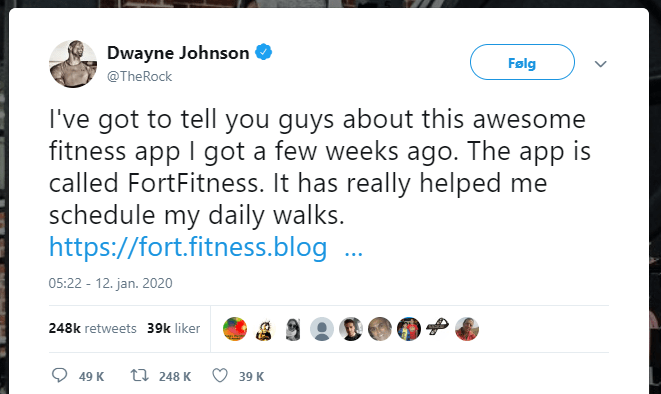
The marketing will be done by us and our partners: Google and FitBit. Google and FitBit can advertise through their own channels, while we (the developers) can continue the marketing on social media and through promotional videos on YouTube and other video sites. If we are able to gather enough funds we could even try to get a celebrity to promote our app.

Dwayne

There is another way of acquiring funds that is more questionable. Some companies have a great interest in purchasing data collected from users. If the users of our app gives us permission to collect their data, then this is something that could be done although we’re not interested in obtaining funds through this manner given the ethical questions surrounding this topic.

There might be other avenues of income, but these are the ones that we’ve thought about and discussed so far. (Whether or not the approach detailed in this blog post is ideal for our app is uncertain, but it’s probably the model we would aim to use if we were going to develop this as an actual app.)

  • Eirik J. Henriksen

Usage of resources

The magic potion pot is among the ways the user can use and spend resources on. Creating the magic potion pot is a part of the initial tutorial and will look something like this:

Make a magic potion pot for creating items!

Requirements: 5 Fire Herbs and 3 Magic Crystals

On complete: “You’ve unlocked the magic potion pot! Use it to not only make potions but to make various and different mystery items. Do more quests to unlock more recipes for the magic potion pot”.

The magic potion pot can be used to create all sorts of items like potions, cosmetic items, upgrades etc. A recipe needs to be followed to in order to create an item, or else the magic potion pot will return garbage if the resource combination does not exist. The two types of recipes are individual recipes and public recipes. Individual recipes are recipes that requires different resources per user. Public recipes however requires the same resources for everyone so that someone who has unlocked a public recipe may share it with other users.

Recipes can be unlocked by completing quests. Here is a typical example:

“I’ve made some Clarity Cookies at Outpost Bravo, but I was distracted by Rainbow Rats on the way to the fort so I lost them on the way. Could you go and fetch them for me?”
Reward: 5 number of Clarity Cookies and Clarity Cookie recipe.

This game mechanic plays a lot on Malone’s Theory of Intrinsic Motivating Instructions. The quests acts on the hidden information and random factor, and that itself invokes curiosity for the user. This is also a part of the fantasy that revolves around creating items in a magic cauldron with resources gathered from different outposts.

  • Edvin Gammelsæter


Resources

There are a few different types of resources that the user can gather in the app. Resources are gathered by establishing outposts on the map and letting them accumulate over time, and then walking to them to collect.

Skjermbilde
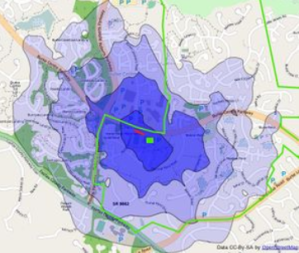
Example of what one of the zones could look like on the map. The darker the area the higher the resource multiplier.

Resource zones

Resource zones are concentrated areas of resources overlaying the world map. These zones are procedurally generated when the user first uses the app. Resource zones may migrate over time and change places, and new ones can appear.

The user can’t see the zones unless they have built a magical tower that can detect the different resource zones within a certain radius.

When building an outpost in a neutral area it will accumulate 1x its resource. Building in a resource zone yields bonus resources. The zone has multiple layers and the innermost layer gives the highest multiplier (2x), and the outer one yields the lowest (1.2x).

Building a resource outpost at a resource zone of a different type may cause you to obtain resources at a lower rate (0.8x at outer and 0.1x at the inner layer).

Types of resources

Steps => Experience points – Unlocks building types and upgrades. Steps will never deplete, but will unlock “blueprints” and achievements. (Blueprints will allow the user to construct new buildings and access new upgrades.)

Resource Ω => Gold coins. (Requires marketplace or a smelter.)

Resource A => Magic Crystals. (Requires a mine.)

Resource B => Liquefied infinity. (Requires a magic well.)

Resource C => Fire herbs. (Requires a garden.)

Resource D => Shady Mushrooms (Requires a dark cave.)

Resource E => Griffin feathers (Requires a griffin nest.)

Resource use

The resources can either be traded for gold or other resource types at a marketplace. Certain upgrades or quests given to the user will require certain resources.

We aim to make the the app more fun and rewarding through having different resources with various uses that inspires the user to gather resources and to upgrade outposts in a more strategic manner.

  • Eirik J. Henriksen

The Quiz

Our app starts off with a short quiz. The quiz will determine how the player will use the app initially. The first question is about gender, age, height and weight and the second is about how experienced/active the user is physically. This will decide the base intensity for the user. The preferred intensity will be a variable that decides the level of intensity based on the base intensity. Then there are other questions like if the user want to focus on weight loss and/or has a bike that is often used. The app will strive to streamline itself to accommodate those needs.

The Quiz’s purpose is mainly to find a suitable start intensity for the user, but it is also useful for estimating how quickly the user is able to progress physically. Older people may not be able to progress physically as fast as young people for example. People who have experience beforehand but have been sedentary for a while may also have an advantage, and other people who are still active physically may be close to plateauing and are already at a high level of intensity but are progressing very slowly.

The surroundings also plays a big role as that affects how the user will be placing the outposts. Someone who lives on the country-side may be limited on how many roads to walk on and places the user can place outposts on compared to someone who lives in a city. How this will be balanced is a limit on outposts. Countryside outposts are more limited than city outposts but are more effective and stronger since there are fewer of them.

  • Edvin Gammelsæter

Theories Behind Gamification

Chapter 3 of The Gamification of Learning and Instruction describes different theories used for gamifications. (Kapp, 2012, p. 51)

We are designing a gamified walking app. Not all the theories will be as useful. Let’s take a look at some and how we could apply them.

The ARCS model

ARCS stands for Attention, Relevance, Confidence and Satisfaction. This model focuses on designing instruction, and is therefore particularly useful to us.

The app needs to get, and hold the users attention over time. The app needs to instruct the user to do tasks that are relevant to their goals. The app needs to give the user confidence in what they do. And the app needs to give the user satisfaction along the way.

ARCS model – Attention

Curiosity

We want to take advantage of the user’s curiosity to pull them into the app’s action and motivate them to get out and move.

Variety and chance

The user will experience variety and chance in experiencing a development of opportunities via level-ups by going and finding resources along the way or in resource towers. When resources are retrieved from towers, they can select one of three bonus chests that give them a “random” (at least a seemingly random) amount of resources.

Antici…pation

The user’s curiosity is stimulated when they can look at the overview of possible towers that can be unlocked and built. The same applies to upgrades on these buildings and the home base that the user creates.

Guide

A virtual guide that initially gives the user a set of tasks. Later, the guide keeps track of progress, statistics, etc. with the user. This guide should appeal to the user and therefor they get to choose on from a gallery of characters.

Conflict

What can be considered the conflict to be solved is the very problem this app will solve for the user: getting out of the couch and moving more.

ARCS model – Relevance

Goal orientation

The user sets his own goals. The app will then guide the user in how the goals will be implemented. The user is challenged to race by characters that the user can meet at buildings. They push the user to travel slightly faster than they otherwise would.

Motives

The goal is to match the user’s motives. The user inputs what they want to do (Go long walks, short walks, jogging, cycling, etc), but the app also calibrates by what the user actually does. So if the user says they are interested in walking, but mostly goes jogging, we can assume that is what they are most interested in.

Show result of effort

We will show the results by giving the user an overview of statistics related to what they have achieved and their use of the app. The app can show estimated calorie burn and other things. Each session will be saved and can be reviewed by the user later.

The bet can also be displayed by visually displaying upgrades and status of constructed towers and records on the map in the app.

ARCS model – Confidence

Learning curve

The first week of the app will analyze the form of the user and then provide a custom plan to the user. Progression eventually becomes easier to calculate.

Different quests / quests can occur on the different towers that the user has posted to give the user unique opportunities to complete their goals.

Dynamic difficulty

The app can record how the user does it according to quest completion and challenges. It will use this information to try to balance the challenges in such a way that the user gets an affordable challenge.

ARCS model – Satisfaction

Positive encouragement

The guide character says encouraging phrases like “Good job”, “You did good today”, “Nice pace!”  when the user comes home from a session. (Intrinsic motivation)

Every trip the user does with the app will result in small rewards when the user returns to the home base, in addition to what they gather at buildings. (Extrinsic motivation)

If weight loss is a goal the user has put in, then the virtual guide periodically boasts about calories burned. The virtual guide can tell you how much you’ve improved, for example, “You are jogging 4 minutes less between tower 3 and tower 4 than you did a month ago,” and so on.

Consistent Measurement of Success

Data is stored for each trip. After each trip, the user gets an overview of the trip; map, time, speed, calories burned. If the same route has passed earlier, the app can tell if the day’s walk was faster than average.

Virtual characters sometimes show up on posts and challenge the user. Challenges come in some different forms. The user will most often meet those matching the users interests. If the user is interested in jogging further, they will be challenge to jog to a certain distance away. Challenges will become progressively harder with completion. Maybe the challengers level up to match your skills.

Lepper’s instructional design principles for intrinsic motivation

Control

The user sets their own goals at the start of the app. Here the user has control over which days, how often etc.

Operant conditioning

“a concept used in many games to keep players engaged for long periods of time, a variable ratio reinforcement schedule.” The app can use unpredictable intervals on rewards to keep interest over time.

Social learning theory

People are influenced by others, including virtual characters. Therefore, we will have a character in the app that acts as a guide for the user. The user chooses who will be their guide based on a small character gallery. The characters have different looks and to a small extent different personalities, so that the user can find someone they like. The guide must be a mentor and role model. They can give advice and encouraging messages. If the mentor says that it went a long walk and that it felt good, the user will be socially influenced to think in those paths themselves.

Flow

To allow the user to find a flow in the walk itself, the app must not be a distraction. The user should not need to look at their phone while they are outside. It should be enough to check your route before and after the walk. Exceptions are when you create a new building, and when you start a challenge.

Sources

Kapp, K. M. (2012). The Gamification of Learning and Instruction. John Wiley & Sons Inc.

:: Written by Anette Rana ::

 

Developing a simulation


Developing an app that enhances a users daily behavior is no simple task. To achieve this we need to know how the user and the app affect each each other. To do this we want to make a simulation.

The first step to making a simulation is to break down the systems that make up our app and the behavior of the user into components. Then we can study how these parts affect each other. Identifying these components can be difficult. One of the big things is to figure out what will have an significant impact on the users motivation. If the user has low motivation, the likelihood of the app being used is also low, so we need to find a way to keep their motivation up. This can be achieved through making the app fun to use, and also by rewarding the right behavior, which in this case would be a trip to an outpost from the fortress. Simulating psychological aspects is challenging because it can’t be quantified or measured in certain terms, and different people react differently to certain elements. This is why it is important to adhere to the target audience as this makes our task more manageable.

Analyzing how the components affect each other is an ongoing process that we’re currently working on. The goal is to use what we learn to construct a simulation that can help us solve design problems and make the app fulfill its goal and be more user friendly.

  • Eirik J. Henriksen

Comparing similar idéas and Fort Fitness’ use of AR-technology

https://link.springer.com/article/10.1007/s11042-011-0985-9

In a research study written by Kuei-Fang Hsiao tells us about students’ physical fitness problem in Taiwan. He explains that due to the growing volume of high-tech entertainment and public transport being commonly available throughout the day has made it so that the young people’s general health is deteriorating. Their idéas revolve around using cameras and tracking the students movements to match up with a screen in order to exercise. An example would be the stepping interfaces which has virtual stairs appear on a projector-screen in which the students see themselves from the camera walking up steps of a staircase.

Fort Fitness however does not utilize a camera for its AR-technology, but rather the GPS on a smartphone. A virtual world is contained in Fort Fitness which is linked up to the real world’s coordinates. Like an otherwise normal GPS-app the user will be shown a map and where he/she is on the map. The user is able to place virtual structures in the map in Fort Fitness which are connected to real world coordinates. The GPS is useful as we can use it track distance walked/jogged/run in conjunction with the smartphone’s pedometer, as well as use it for gamifying purposes.


• Edvin Gammelsæter

Target Audience

This app is made for walking, and that’s just what it’ll do.
One of these days this app is gonna walk around with you.

Walking is for most people a simple task. Many also find it boring. There is already an abundance of walking apps that help motivate people. We think there is room for another, one which aims to reach a new audience.

It can be hard to define a specific target audience, and even harder to keep them in mind when developing. Therefor we use target audience personas, which are fictional character who represents our target audience. As we are designing the app and market stratergy, it is with these users in mind, rather than just a loose idea of age group.

In general our users will be motivated to walk, but needs an extra push to get out the door.

Target Audience Personas

personas1-01
Name:
Martin
Age: 32
Gender:
 Male
Marital status:
Single
Location: Hamar, Norway
Occupation: Graphic designer
Interests:
 Football, pub with friends, politics, technology. 
Lifestyle:
Likes walking but does not have a habit to do so. Often bikes to work in the summer. Eats fast food a bit too often. Lifts weights a few times a year with friends, but rarely alone. 
Wants from app:
He wants motivation to be active on his own, and likes the idea of a game which is played by walking.
Concerns about the app: He might not get enough motivation to start using it, if it’s too complex OR just another tracking app.

personas2-01
Name:
Emily
Age: 19
Gender:
 Female
Location: Reading, UK
Occupation: Student
Interests:
 Social media, music, writing, travel, friends.
Lifestyle:
Walks a few times a week regularly. It is her main physical activity, and she wants to keep it that way. She enjoys being able to clear her mind while walking, but sometimes struggles to find the motivation to get out.  
Wants from app:
Wants to make walks more fun so she can walk more often. Already uses a GPS fitness-tracking app, but likes the idea of creating landmarks in the area and getting small challenges.
Concerns about the app: Doesn’t want it to take too much focus or time.


:: Written by Anette Rana ::