Budget – Development & after release

To accomplish our goal of making this app a reality, we will need to set up a reasonable and realistic development budget and income model. (Since this is just a school project we will not set up an actual budget, but we will rather look at different possibilities and ways of funding our app before and after release.)

Part of our funding will be secured by our partners: Google and FitBit. Another source of  funds is to apply for a government grant, and given the health focus of our app this would seem like a realistic goal. We could also look into possible partnerships with various sports brands like adidas and nike, and advertise their brands within our app.

Once the app has been released (possibly without all planned features due to budget constraints) we will generate income both through ads displayed in our app and through sales of our ad-free version. If the app generates enough income it would be possible to complete and fully implement all planned features. In addition to this we might be able to expand our app with a merchandise store where our users can buy different items with “FortFitness” branding (t-shirts, hats, etc.) but only if our app becomes popular enough.

As mentioned; our app will have two versions, one that is free to download, but with ads and limited functionality (No achievements, not as detailed stat tracking, etc.). The other version will be an ad-free and a fully functional version of the app. The cost of unlocking the app will be about 34,99 NOK. Similar apps were found to have about the same price range.

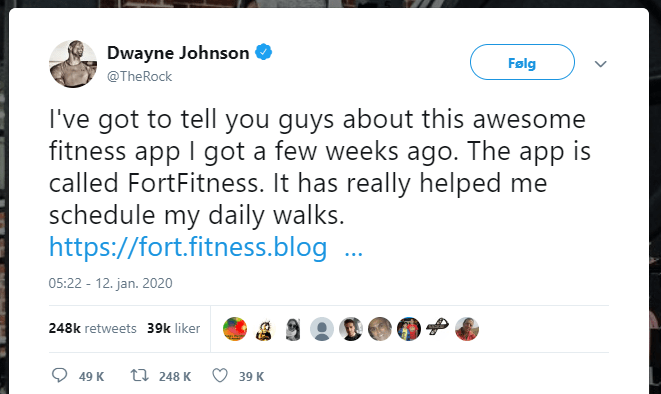
The marketing will be done by us and our partners: Google and FitBit. Google and FitBit can advertise through their own channels, while we (the developers) can continue the marketing on social media and through promotional videos on YouTube and other video sites. If we are able to gather enough funds we could even try to get a celebrity to promote our app.
Dwayne

There is another way of acquiring funds that is more questionable. Some companies have a great interest in purchasing data collected from users. If the users of our app gives us permission to collect their data, then this is something that could be done although we’re not interested in obtaining funds through this manner given the ethical questions surrounding this topic.

There might be other avenues of income, but these are the ones that we’ve thought about and discussed so far. (Whether or not the approach detailed in this blog post is ideal for our app is uncertain, but it’s probably the model we would aim to use if we were going to develop this as an actual app.)

  • Eirik J. Henriksen

Resources

There are a few different types of resources that the user can gather in the app. Resources are gathered by establishing outposts on the map and letting them accumulate over time, and then walking to them to collect.

Skjermbilde
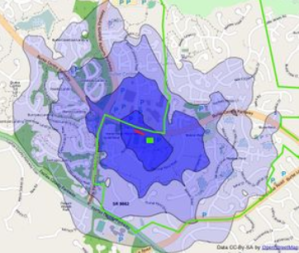
Example of what one of the zones could look like on the map. The darker the area the higher the resource multiplier.

Resource zones

Resource zones are concentrated areas of resources overlaying the world map. These zones are procedurally generated when the user first uses the app. Resource zones may migrate over time and change places, and new ones can appear.

The user can’t see the zones unless they have built a magical tower that can detect the different resource zones within a certain radius.

When building an outpost in a neutral area it will accumulate 1x its resource. Building in a resource zone yields bonus resources. The zone has multiple layers and the innermost layer gives the highest multiplier (2x), and the outer one yields the lowest (1.2x).

Building a resource outpost at a resource zone of a different type may cause you to obtain resources at a lower rate (0.8x at outer and 0.1x at the inner layer).

Types of resources

Steps => Experience points – Unlocks building types and upgrades. Steps will never deplete, but will unlock “blueprints” and achievements. (Blueprints will allow the user to construct new buildings and access new upgrades.)

Resource Ω => Gold coins. (Requires marketplace or a smelter.)

Resource A => Magic Crystals. (Requires a mine.)

Resource B => Liquefied infinity. (Requires a magic well.)

Resource C => Fire herbs. (Requires a garden.)

Resource D => Shady Mushrooms (Requires a dark cave.)

Resource E => Griffin feathers (Requires a griffin nest.)

Resource use

The resources can either be traded for gold or other resource types at a marketplace. Certain upgrades or quests given to the user will require certain resources.

We aim to make the the app more fun and rewarding through having different resources with various uses that inspires the user to gather resources and to upgrade outposts in a more strategic manner.

  • Eirik J. Henriksen

Developing a simulation


Developing an app that enhances a users daily behavior is no simple task. To achieve this we need to know how the user and the app affect each each other. To do this we want to make a simulation.

The first step to making a simulation is to break down the systems that make up our app and the behavior of the user into components. Then we can study how these parts affect each other. Identifying these components can be difficult. One of the big things is to figure out what will have an significant impact on the users motivation. If the user has low motivation, the likelihood of the app being used is also low, so we need to find a way to keep their motivation up. This can be achieved through making the app fun to use, and also by rewarding the right behavior, which in this case would be a trip to an outpost from the fortress. Simulating psychological aspects is challenging because it can’t be quantified or measured in certain terms, and different people react differently to certain elements. This is why it is important to adhere to the target audience as this makes our task more manageable.

Analyzing how the components affect each other is an ongoing process that we’re currently working on. The goal is to use what we learn to construct a simulation that can help us solve design problems and make the app fulfill its goal and be more user friendly.

  • Eirik J. Henriksen

What is FortFitness?

FortFitness is an application (app) for your smart-phone. You might wonder what this app is all about! Let me give you a quick introduction:

Our goal is to develop an app that will encourage people to walk more. We want to achieve this through the game mechanics more commonly associated with resource management games. The user will start by defining their starting point, also known as their fortress (hence the app name). The user will then have to establish a watch-post a certain distance from their fort. To establish this outpost they must walk, as it must be built at the location where the user actually is. They will later be encouraged to construct more outposts. To be able to build these, the user will need to gather points. They will be able to accumulate these points by walking. After an outpost has been established it will start to gather certain resources that can be used to further expand the users territory. To collect the resources the user must physically walk from their fortress and to their outpost. The resources in addition to the points generated by walking will be used to upgrade the constructions made by the user and their fort. The physical steps the user makes will also contribute to them gaining levels and give them access to new constructions and skills.

We intend for this app to give users the added motivation they need to get out and move, and eventually through exercise and positive reinforcement, they’ll be able to keep this lifestyle going on their own!

(More details to follow in subsequent posts!)

  • Eirik J. Henriksen